We Looked at Every Music Collaboration Tool Out There. Here's Why None of Them Do What We Do. | musiciansXchange Blog
By Platform Admin — March 31, 2026
We Looked at Every Music Collaboration Tool Out There. Here's Why None of Them Do What We Do.
Published: March 31, 2026 · Updated July 3, 2026
There are a lot of music collaboration tools out there. We know — we studied all of them before building musiciansXchange. And after looking at every option available to music creators in 2026, we found something surprising: nobody is doing what we're doing.
Not because we're smarter. Because the industry keeps solving the wrong problem.
The Five Buckets (and Why They All Miss)
Every music collaboration tool on the market falls into one of five categories. Each one solves a piece of the puzzle — but none of them solve the whole thing.
1. Browser DAWs — "Use Our Tools Instead of Yours"
Examples: BandLab, Soundtrap by Spotify, Avid Cloud Collaboration
These platforms want to be your studio. They give you a DAW in the browser — instruments, effects, mixing, the works. Collaboration means everyone working inside their system.
The problem? If you've spent years dialing in your workflow in Logic, Ableton, FL Studio, or Pro Tools — none of that transfers. Your plugins don't work there. Your templates don't exist there. You're starting from scratch in someone else's sandbox.
And increasingly, these "free" platforms are locking features behind paywalls. BandLab now charges $15/month for features that used to be free. Collaborator limits. Project limits. It adds up fast.
What they get right: Easy to start.
What they get wrong: They force you to abandon your tools.
2. Real-Time Jamming — "Play Together Live"
Examples: JamKazam, AudiGo, LANDR Sessions, Sessionwire
Cool technology. You plug in your instrument, connect to the internet, and jam with someone across the country in near-real-time. Low latency audio streaming. Virtual rehearsal rooms.
But songwriting isn't jamming. Building a track — recording stems, refining parts, mixing versions — is an asynchronous process. You need to upload a guitar part Tuesday, have your drummer lay something down Thursday, and compare both versions the following week. Live jamming tools don't solve that.
What they get right: Real-time performance is legitimately impressive.
What they get wrong: Most music collaboration doesn't happen in real time.
3. Audio File Sharing — "Better Dropbox for Music"
Examples: Pibox, Splice, Opusonix, Samply, Bounce Boss, Aliada
These are the most practical tools available right now. Upload stems. Leave timestamped comments on waveforms. Track versions. Share files with collaborators.
Good stuff. We respect these tools. But here's the gap: they assume you already know who you're working with. There's no way to discover a bassist in Austin or a vocalist in Lagos. No community. No profiles. No way to browse open projects and jump in. They're tools for existing teams, not platforms for finding new ones.
What they get right: Solid audio review and versioning workflows.
What they get wrong: Zero discovery. You're on your own to find collaborators.
4. Talent Marketplaces — "Hire a Musician"
Examples: SoundBetter, Vocalizr, ProCollabs
Think Fiverr, but for music. Post a gig, set a budget, hire a session vocalist or mixing engineer. Transactional. Work-for-hire.
Nothing wrong with this model — sometimes you just need to hire a pro. But it's not collaboration. There's no shared workspace. No back-and-forth creative process. No place the work lives together. No long-term creative relationship. You pay, you get files, you move on.
What they get right: Efficient for one-off paid work.
What they get wrong: Hiring isn't collaborating.
5. Music Social Networks — "Find Collaborators Online"
Examples: CoCreatea, Kompoz, Muibas, SoundStorming
These are the closest to what we're building — platforms where music creators connect, share ideas, and collaborate on songs. Some support uploading stems. Some have project management features.
But the execution tends to be rough. Forum-style interfaces from 2012. No clear current version. No real audio workflow. The discovery is there, but the tools to actually work together once you've connected are missing.
What they get right: The idea that creators need a place to find each other.
What they get wrong: The actual collaboration workflow once they do.
So What Makes musiciansXchange Different?
We're the only platform that combines all five pieces into one:
🎛️ Use Whatever DAW You Want
We don't care if you use Ableton, Logic, FL Studio, Pro Tools, Reaper, GarageBand, or a four-track cassette recorder. musiciansXchange is DAW-agnostic by design. Upload your stems in WAV, MP3, AIFF, FLAC, M4A, or AAC. Your collaborator downloads them, works in their own setup, and uploads their parts back. Your tools are your tools. We're not here to replace them — we're here to connect them.
🔍 Find Your Collaborators
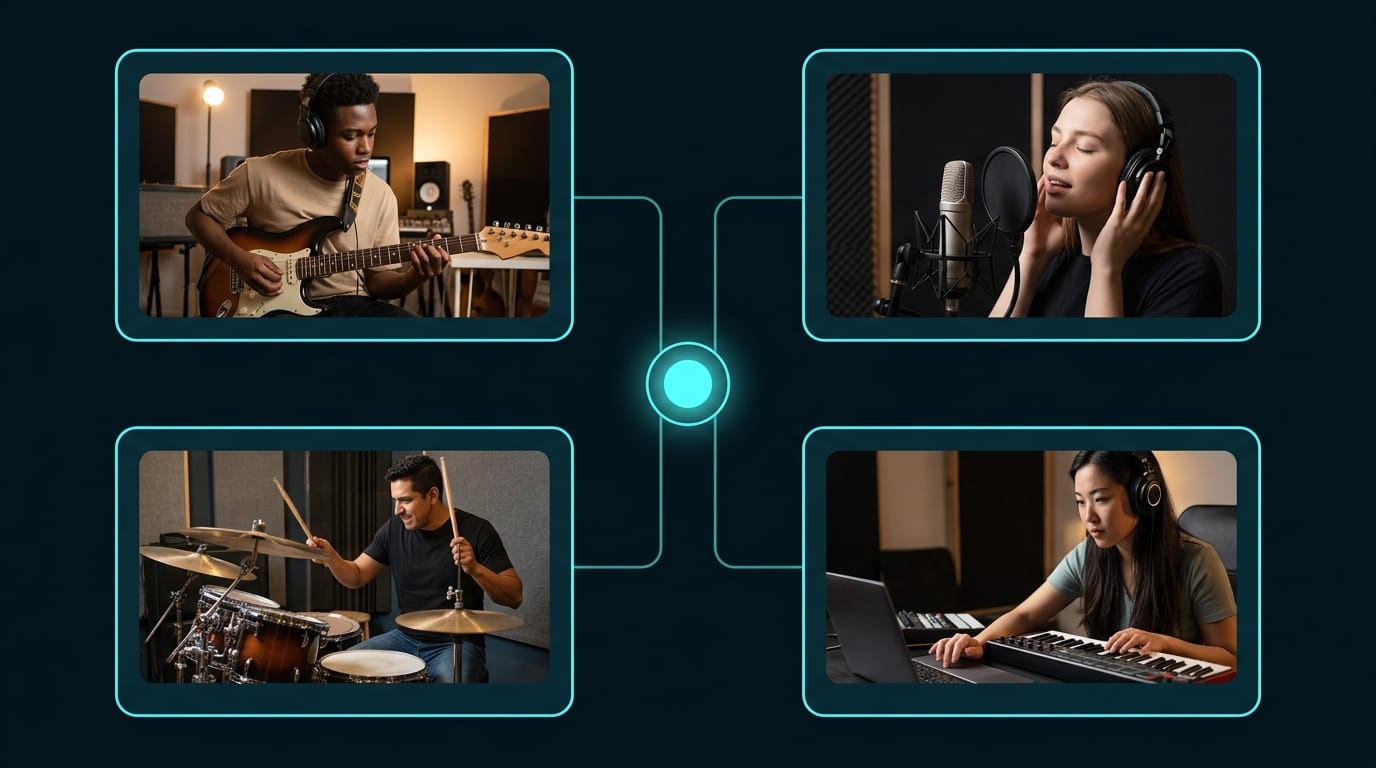
Search by instrument, role, genre, skill level, and location. Browse profiles. Listen to what people have contributed. Find the drummer you didn't know you needed, the mix engineer for your next single, or the vocalist who takes your track to another level. This isn't a job board. It's a community where creative partnerships start organically — the same way they do when musicians bump into each other at a local open mic, except the open mic is global.
📌 One Current Version, Always
Every track has exactly one authoritative "current" version — named clearly and matched to its actual audio, not just whatever the filename claims. Upload a new take and — once it's approved — it becomes the current version; nothing gets silently overwritten, and every earlier upload is still there if you need to go back. You'll never see final_mix_v3_REAL_FINAL_v2.wav again.
No more guessing which file is the real one. No more three collaborators mixing three different "finals." Just one track, clearly labeled, that everyone on the project can trust.
💬 Feedback in Context
Timestamped comments tied to specific points in the audio. Not "I think the chorus needs work" in a text thread — but a comment pinned to 1:42 in the waveform that says exactly what needs to change. Collaboration gets faster when feedback is precise.
🔒 Private Sharing You Can Actually Trust
Unreleased tracks are sensitive. So sharing them is access-controlled: you invite a real, resolved account — not a typed email address that can bounce to the wrong inbox. An invitee can preview the seed track to decide, but the rest of the private workspace stays locked until they accept — and every download is logged, so you always know who has a copy of your work.
And when it's time to bring in a team, the whole private workspace — what we call Backstage — is one seat for the host. Invite as many collaborators as the song needs; they join free. You're not paying per person just to let people help you finish a track.
🎤 Showcase Your Work Together
Finished tracks live on the platform with every collaborator listed alongside it. It's a portfolio for everyone involved. When someone discovers a great track in the Showcase, they can see who worked on it — and reach out for future collaborations.
The Gap Nobody Filled
Here's the simplest way to see it:
Others: CoCreatea, Kompoz (basic)
Others: Splice, Pibox (partial)
Others: Opusonix, Aliada (limited)
Others: Pibox, Samply
Others: BandLab (locked to their browser DAW)
Others: Splice, Pibox (versions, but no single "current")
Others: Nobody
Others: Nobody
Others: Nobody
You can cobble together five different tools and hope they play nice. Or you can use one platform that was designed from the ground up for the full collaboration workflow — from finding people to shipping music.
What We're Not
Let's be clear about what musiciansXchange is not, because knowing what we don't do is just as important:
- We're not a DAW. We don't want to be. Keep using the tools you love.
- We're not a streaming platform. We're the workspace, not the stage. Use Spotify, Apple Music, SoundCloud, or wherever you distribute.
- We're not a hiring platform. We're about collaboration, not transactions.
- We're not trying to replace your existing workflow. We're filling the gap in the middle — the part where you need to find people, share work privately, and always know which version is the real one.
🎁 Founding Member Offer — First 500 Musicians
We need believers, not just customers.
The first 500 musicians to sign up get grandfathered into the Unlimited tier — completely free, for life. No catch. No expiration. You believed in us early, and we won't forget that.
Once those 500 spots are filled, they're gone for good.
Claim Your Spot →Ready to See What's Different?
Music Is Better Together. That's not just a tagline — it's why every feature on this platform exists.
Keep your DAW. Find your people. Build music together with one version that's always clearly the current one.
Sign up free →