
Songs Become Releases. Introducing Projects.
By Platform Admin — August 5, 2026

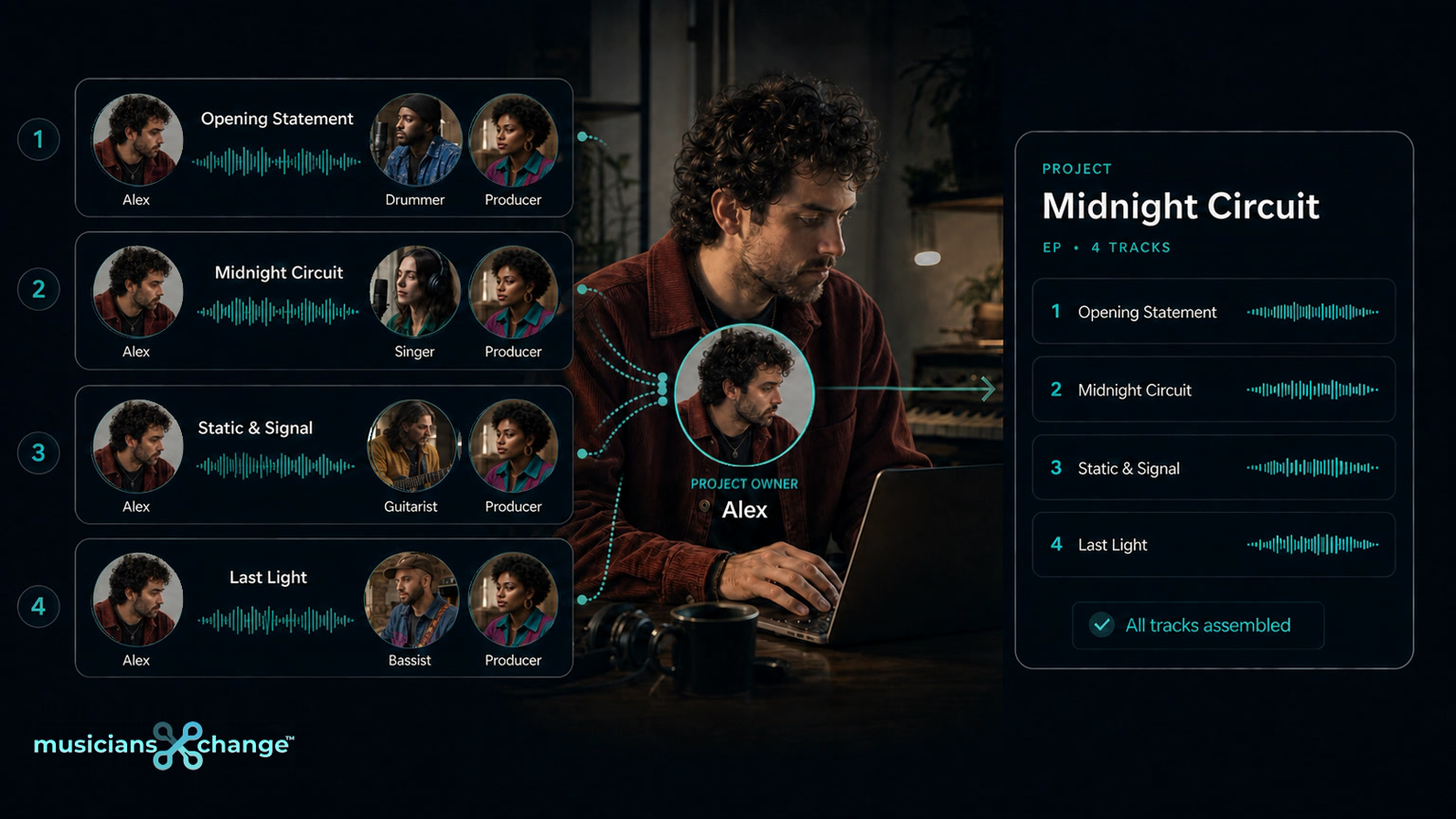
Songs Become Releases. Introducing Projects.
Published: August 5, 2026
musiciansXchange began with a simple problem: music collaboration had outgrown the tools musicians were being forced to use.
Cloud folders can store files. Message threads can carry conversation. A shared drive can hold a dozen bounces named final, final-final, and use-this-one. But none of that gives a song a real memory.
That is why musiciansXchange was built around song workspaces. A workspace gives one song a clear home: the audio, the stems, the versions, the comments, the decisions, the collaborators, and the credit that belongs to that piece of music.
But music does not always stop at one song.
One workspace becomes three. Three songs become an EP. A few writing sessions become an album. A client record starts to take shape. Suddenly the question is not only, “Which mix is current?” It becomes, “Which songs belong together, what order are they in, who is involved, what is finished, and what are we releasing?”
That is why we added Projects: to give a release a home without taking control away from the individual song workspaces inside it.
A Song Workspace Is Still the Source of Truth
This distinction matters.
In musiciansXchange, a song workspace still owns the song. It owns the files, versions, branches, comments, votes, collaborators, permissions, approvals, audit history, and credits connected to that song.
A Project does not replace that workspace. It does not merge every song into one giant folder. It does not flatten access. And it does not automatically expose every workspace to every person in the Project.
A Project can contain workspaces that some Project members do not have access to.
That is intentional.
A vocalist may only need access to the song they sang on. A drummer may be involved in three tracks. A mix engineer may only need the songs they are mixing. A producer, artist, or studio owner may need visibility across the larger release. Each song still needs its own boundaries, because each song may have its own people, files, decisions, and permissions.
Projects organize the release without breaking those boundaries.
That is the balance Projects are meant to protect. The release needs a shared structure, but each workspace still has its own team and its own rules. A Project can show that a song belongs to the EP without turning that song into an open room for everyone attached to the EP.
For unreleased music, that is not a small detail. It is the difference between useful organization and accidental exposure.
Workspaces Protect the Songs
Each workspace keeps its own collaborators, files, permissions, version history, comments, decisions, and credits.
Projects Organize the Release
The Project gives the larger body of work a home: song list, running order, cover art, release date, and release-level organization.
Why Projects Had to Exist
As musiciansXchange continues to evolve, every feature has to answer the same question: does this make real collaboration easier?
Projects answered that question immediately.
A single song workspace solves one layer of collaboration. It gives the team clarity around a specific track. But releases create another layer of work that does not belong inside any one song:
- Which songs are part of the EP?
- What is the running order?
- Which tracks are still being written, recorded, mixed, or mastered?
- What cover art belongs to the release?
- What release date is everyone working toward?
- Which songs are active, and which are already finished?
- Where does the record live after it is done?
Before Projects, that information usually lived somewhere else. A spreadsheet. A notebook. A shared drive. A message thread. Or worse, in one person’s head.
That creates the same kind of collaboration friction musiciansXchange was built to remove. The music may be organized at the song level, but the release is still scattered.
Projects give that release-level work a place to live.
Instead of treating every song like an island, Projects let the larger body of work take shape. You can start to see the record as a record: the opener, the transition track, the single, the closer, the songs still waiting on a vocal, and the mix that is ready for mastering.
That visibility changes the way collaborators talk about the work. The conversation moves from “where is that file?” to “what does this release still need?”
Not Another Folder
A folder holds files. A Project holds context.
That difference is important because music collaboration is not just storage. It is people, access, versions, decisions, and creative responsibility.
If Projects were just folders, they would flatten everything into one pile. That is not how real records get made.
Real records involve different contributors at different stages. Some collaborators are part of the whole release. Some are part of one song. Some should be able to see the full Project structure without opening every workspace inside it. Some should only ever see the song they were invited into.
musiciansXchange Projects are designed around that reality.
The Project Connects the Work Without Collapsing the Permissions
Adding a workspace to a Project helps organize the release, but the workspace still decides who can access the song, hear the audio, review versions, leave comments, and participate in that collaboration.
That gives teams a better structure for albums, EPs, studio work, and client records without sacrificing the privacy and control that unreleased music requires.
It also lets different kinds of teams work the way they need to work. A band can organize an EP. A producer can oversee a collection of songs with different vocalists. A studio can keep a client record grouped together. A songwriter can gather demos that may become a release later. The Project gives the larger effort a place to live while the workspaces continue to protect the individual songs.
From Current Mix to Complete Release
The previous step in musiciansXchange was about version clarity: knowing which mix is current, what changed, who approved it, and which file belongs back in the DAW.
Projects build on that foundation.
Once each song has a reliable workspace, the next problem is organizing the songs together. A release needs more than separate tracks. It needs sequence, direction, timing, artwork, and a way to move from active work into finished history.
With Projects, musicians can group song workspaces into the larger body of work they belong to. Add the songs. Arrange the running order. Attach cover art. Set a release date. Keep active releases visible. Archive finished work when the record is done.
The goal is not to add complexity. The goal is to make the shape of the work easier to see.
There is a difference between having six songs somewhere in the system and having an EP with a track one, a track two, a cover, and a release date. Projects make that difference visible.
That matters creatively too. Running order is not just administration. It changes how the record feels. A song that works as track two may not work as the closer. A heavy song may need space before it. A ballad may change the emotional center of the release. Projects give those decisions a home next to the work itself.
Finished Work Should Stay Finished
A lot of collaboration tools act like everything is permanently in progress.
But records get finished. EPs get released. Client projects close. Albums move from active work to history.
Projects can be archived so finished releases do not have to sit beside active work forever. The Project remains available, searchable, and organized, but it no longer competes for attention with the music still being built.
That matters because finished work still has value. The collaborators still matter. The credits still matter. The song history still matters. The decisions that got the record across the finish line should not disappear just because the release is no longer active.
Archiving gives completed work a proper place to rest without pretending it never happened.
As more releases move through musiciansXchange, that history becomes part of the value of the platform. Finished Projects should be easy to find later. Active work should stay clear. Older records should not disappear just because they are no longer on the front burner.
That is part of building for the full lifecycle of music collaboration: idea, recording, review, release, archive, and return when the history matters.
Privacy Is Part of the Workflow
Unreleased music is sensitive. Demos, alternate takes, client work, rough vocals, unfinished lyrics, and early mixes should not become visible simply because someone organized songs into a release.
That is why Project membership and workspace access are not the same thing.
Someone can be part of a Project without having access to every workspace inside that Project. The workspace remains the source of truth for who can see the song, hear the files, review versions, leave comments, and participate in the collaboration.
If you want to share finished music publicly, musiciansXchange gives you ways to do that through your profile and Showcase. But sharing should be intentional. It should not happen as a side effect of organizing songs into an EP or album.
Projects are built to support collaboration without weakening the boundaries around the work.
That permission model will remain important as Projects grow. Better Project-level tools should make access easier to manage, not looser by default. The goal is not to hide permissions from the team. The goal is to make them clearer, more intentional, and easier to act on when the right person needs access to the right workspace.
The Platform Keeps Evolving
Projects are not a finish line. They are another step in the direction musiciansXchange has been moving from the beginning.
The platform started with a belief that music collaboration needed something stronger than file sharing. Then came clearer workspaces, version history, contextual feedback, collaborator roles, credit preservation, desktop handoff, and a roadmap that keeps connecting the creative process instead of replacing it.
Projects continue that evolution by solving the next layer of the problem: how songs become releases. But like the rest of musiciansXchange, Projects will keep improving as real musicians use them.
We are not trying to replace your DAW. We are not trying to become another generic storage drive. We are building the collaboration layer around the way musicians already make music.
That means the platform will keep changing as real musicians use it, test it, challenge it, and tell us what still gets in the way.
That feedback loop matters. musiciansXchange is not being built as a generic productivity tool with music vocabulary pasted on top. It is being shaped around the reality that songs have versions, collaborators have roles, files need context, and creative decisions need to survive the handoff from person to person.
The roadmap is simple: keep removing friction between the people, the performances, the decisions, the files, and the finished music.
Projects Will Keep Growing
Projects are live, but they are not finished evolving.
Organizing song workspaces into a release is the foundation. The next question is what musicians, producers, engineers, studios, and collaborators need around that release once the songs are grouped together.
Should a Project have its own chat so release-level conversations do not get buried inside individual song comments?
Should Project owners be able to manage workspace access directly from the Project view, so inviting a producer, engineer, or guest collaborator to the larger release can also include granting access to the specific workspaces they need?
Should Projects support clearer production stages, task lists, release checklists, liner notes, mastering status, distribution links, or shared deadlines?
These are the kinds of questions we want the community to help answer.
The Direction Is Clear
Projects should make it easier to manage the release without weakening the boundaries around each song workspace. Better organization, better communication, better access control, and fewer places for important decisions to get lost.
For example, a producer may be invited to the Project and need immediate access to several workspaces. A guest vocalist may only need one. A mastering engineer may need final mixes but not early writing drafts. Those workflows should become easier over time while still keeping permissions intentional and visible.
That is how musiciansXchange will continue to evolve: not by guessing what musicians need in isolation, but by listening to how people actually collaborate.
If there is something you want Projects to do next, tell us. The feature is live now, and your feedback will help shape where it goes from here.
Try Projects Today
Projects are live now on musiciansXchange.
If you are working on an EP, album, client record, writing collection, or any group of songs that belong together, create a Project and start organizing the release around the workspaces you already have.
Add the songs. Set the order. Keep permissions where they belong. Archive the release when it is finished.
And as always, we want your feedback. Tell us what works. Tell us what is missing. Tell us what would make your collaboration process better.
musiciansXchange is being built for the music community, with the music community.
The musiciansXchange promise
Music Is Better Together.
Build the songs. Organize the release. Keep each workspace protected. Move the music forward.
Start collaborating free →